

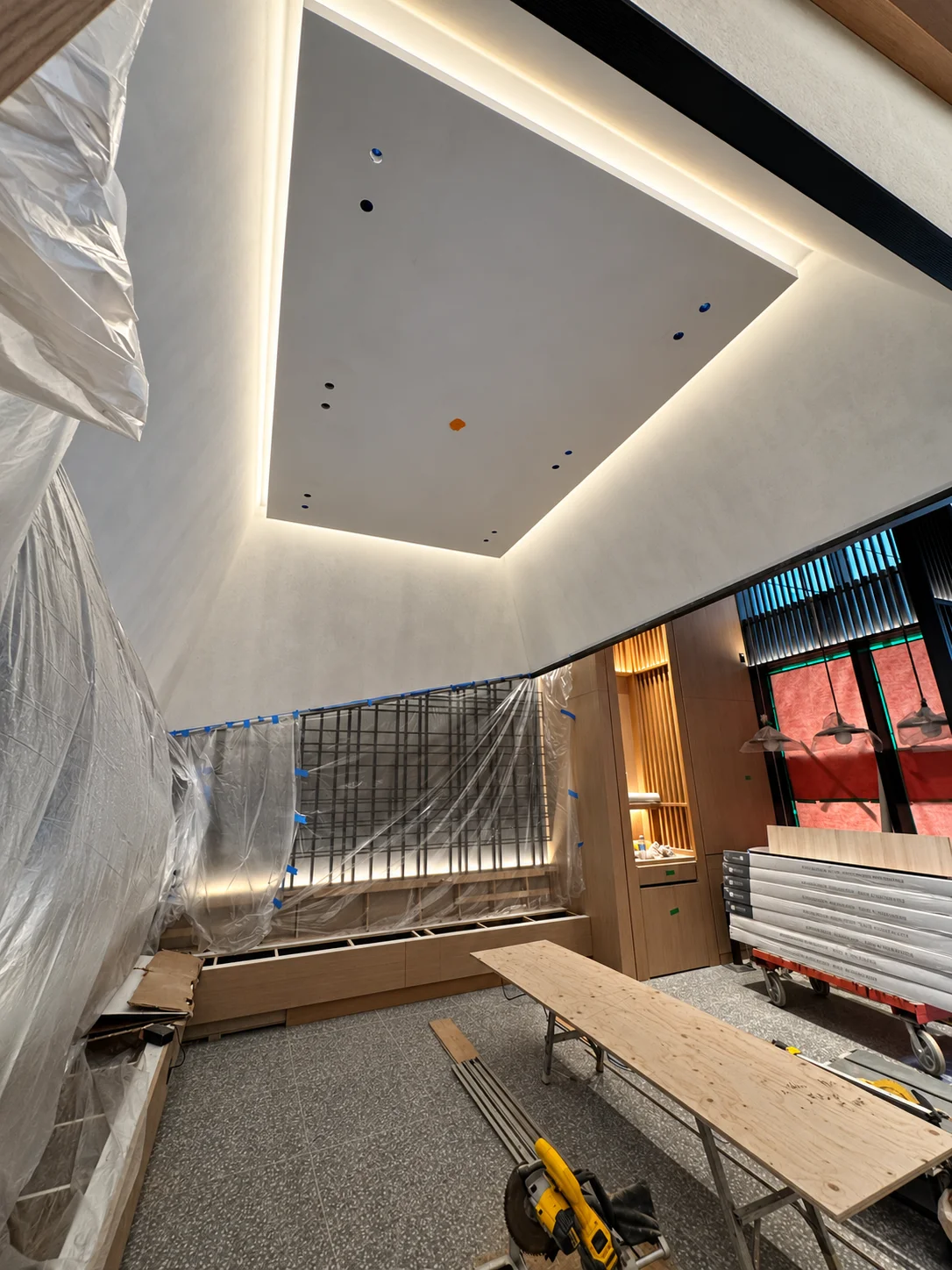
Ceilings rarely get invited into the design conversation. This one did. A dropped ceiling can be more than a practical plane overhead; with the right finish, it can become part of the room’s atmosphere. For a downtown Toronto sushi restaurant, we applied hand-finished limewash to a dropped ceiling, giving the architecture a quieter kind of presence.
Before choosing a direction, we held a comprehensive design consultation and looked at the finish possibilities together. The conversation ranged across faux finishes, lime plaster, Venetian plaster in matte and half-burnished treatments, and velvet plaster, as well as Roman Clay. We considered how each surface’s texture and sheen would meet the room’s light and architecture. The project we’re telling here ends with limewash overhead—but the choice began with seeing the options side by side.
A palette of finishes: comparing visual character
| Finish | Aesthetic character | How it reads in light |
|---|---|---|
| Faux finishes | Technique-led family that can suggest another material, from restrained to expressive. | Pattern, contrast and movement depend on the chosen reference and application. |
| Lime plaster | Mineral, hand-worked surface with irregular nuance and a soft, generally low-sheen appearance. | Texture and tonal variation feel organic rather than mechanically uniform. |
| Venetian plaster — matte | Smooth, refined surface with depth of colour and a quieter, subdued finish. | Low reflection keeps the impression calm and composed. |
| Venetian plaster — half-burnished | Selectively polished finish with more sheen and definition in the trowel movement. | Light catches burnished areas, making movement and contrast more noticeable. |
| Velvet plaster | Soft, suede-like visual impression with diffused tonal depth. | Low sheen and gentle variation create a velvety, less reflective look. |
| Roman Clay | Earthy, matte character with subtle hand-trowelled movement. | Quiet tonal shifts and minimal shine give a grounded, tactile impression. |
| Limewash | Powdery matte appearance with softly clouded colour variation. | Mottled movement shifts gently as daylight changes across the surface. |
This comparison is a visual starting point, not a fixed promise. The chosen finish system, colour, substrate, application, and the room’s natural and artificial light all shape the final appearance. Reviewing samples in the actual space helps make the differences easier to judge.
The room’s interior design was by Fourfold Studio.
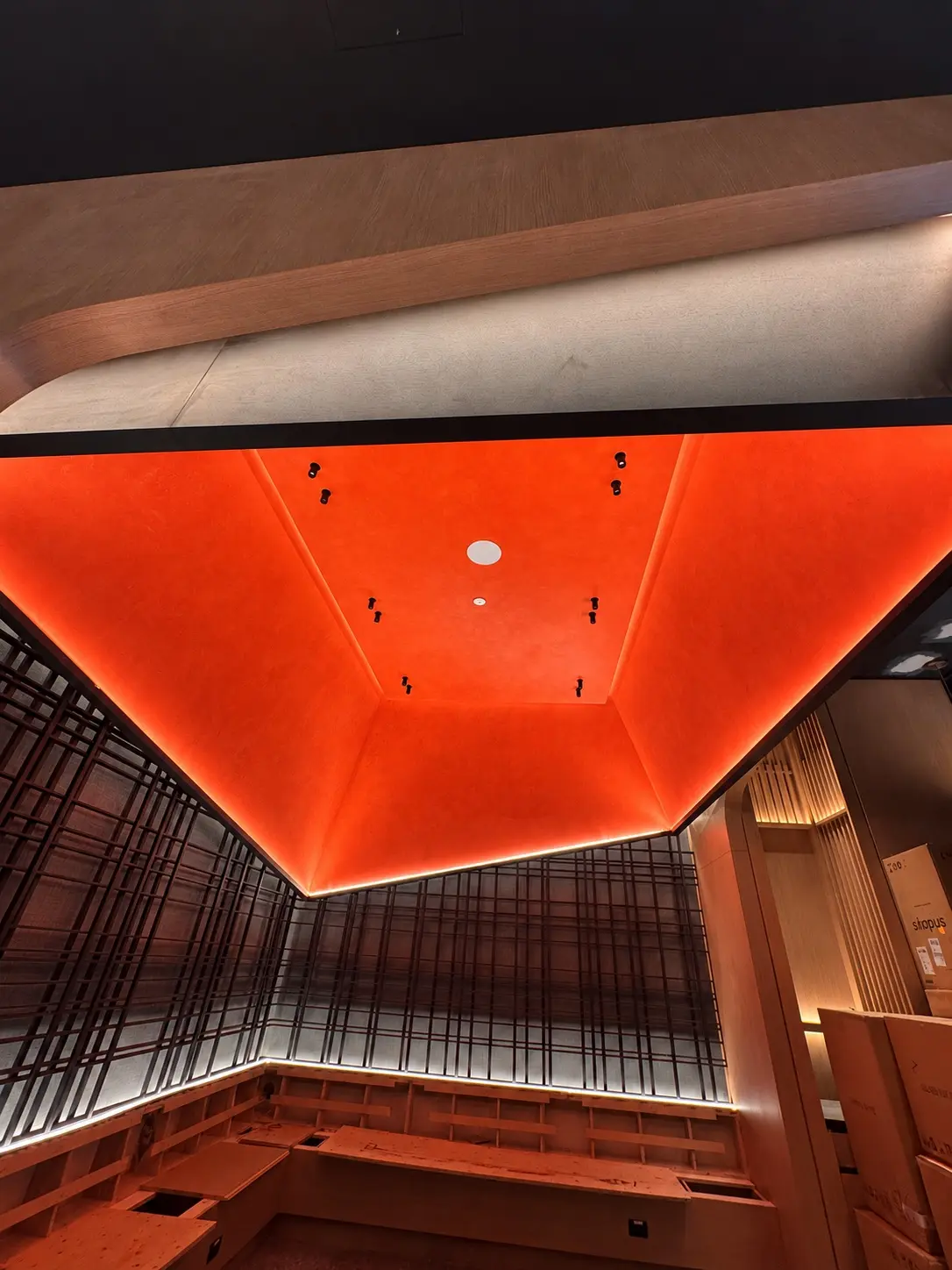
A dropped ceiling, seen in a new light
A dropped ceiling can read as an interruption, or it can help compose the room. Limewash brings gentle tonal movement to a broad plane, so the eye notices the architecture without the finish having to shout for attention. That is the pleasure of a quieter surface: it changes as the light shifts, then lets the rest of the room keep its own voice.
On this project, the lowered plane gave us a clear architectural shape to work with. The aim was not to disguise it, but to finish it as part of the interior. The final appearance of any limewash ceiling depends on the surface, the light, and the way the ceiling meets adjoining walls and details.
Photo placement: wide horizontal photograph of the completed room, composed to show the dropped-ceiling plane in relation to the walls.
What limewash brings overhead
A ceiling is a large surface, but we don’t want it to feel like a large gesture. Limewash can create a soft, matte impression with subtle variation rather than a uniform, high-shine finish. Depending on the light and application, that movement may appear more pronounced at one time of day and recede at another.
Colour needs to be considered with the whole room—not from a small swatch in isolation. Wall colour, trim, flooring, windows, and artificial lighting all affect how a ceiling reads. Reviewing a sample in the space helps make that decision with eyes open.
Photo placement: close detail of the limewashed ceiling, showing the surface movement in room light.
The finish starts with the surface
Before specifying a finish, we look at what is actually overhead: the ceiling material, existing coating, repairs, texture, and condition. Those details affect preparation and whether the proposed finish is suitable. A sound, compatible surface is the starting point; loose, glossy, patched, or inconsistent areas may need attention first. The right preparation depends on what the assessment reveals, not on a one-size-fits-all recipe.
Transitions deserve the same attention as the field of the ceiling. Perimeters, corners, lighting openings, and the point where a dropped plane meets the main ceiling all shape the finished impression. When those edges are considered from the beginning, the ceiling reads as intentional—not like a finish that stopped at the tricky parts.
Photo placement: preparation or in-progress photograph, if available, showing the ceiling surface or a transition before the finish.
Why applying a finish overhead takes care
A ceiling is read from across a room, from doorways, and under changing light. Application has to account for that broad view as well as the smaller details. Working overhead also calls for careful room protection and a controlled sequence so the surface feels coherent from one edge to the other.
There is no universal preparation or application sequence for every ceiling. The selected finish and the existing substrate guide the work. A site review helps determine whether limewash is appropriate and what needs to happen before application.
A ceiling that belongs to the whole room
The best ceiling choice makes sense with the interior around it. If you’re weighing finishes, our decorative ceiling guide looks at other ways to treat the fifth wall. You can also explore our limewash services and the finish options discussed above: lime plaster, Venetian plaster, velvet plaster, and Roman Clay.
Planning a limewash ceiling in Toronto?
Tell us about the ceiling, the room, and the look you have in mind. We can review the surface and discuss a finish direction for the project.