

Some staircases are simply a route from one floor to another. This three-level grand spiral staircase was never going to be.
This microcement staircase in Toronto curved through a Richmond Hill home across three floors, with retained wood treads and an unfinished MDF skirt wrapping around both sides. The geometry had already made its entrance; it simply needed the right finish to hold the room together.
Microcement Spiral Staircase Toronto: Surfacing a Three-Level Grand Staircase
So, naturally, microcement entered the conversation.
Not as an afterthought, and not as a way to disguise the construction beneath it. Microcement offered the possibility of turning the raw MDF structure into one continuous, hand-trowelled architectural surface: quiet enough to let the spiral speak for itself, but rich enough to give every curve a sense of depth, movement and intention.
The Project
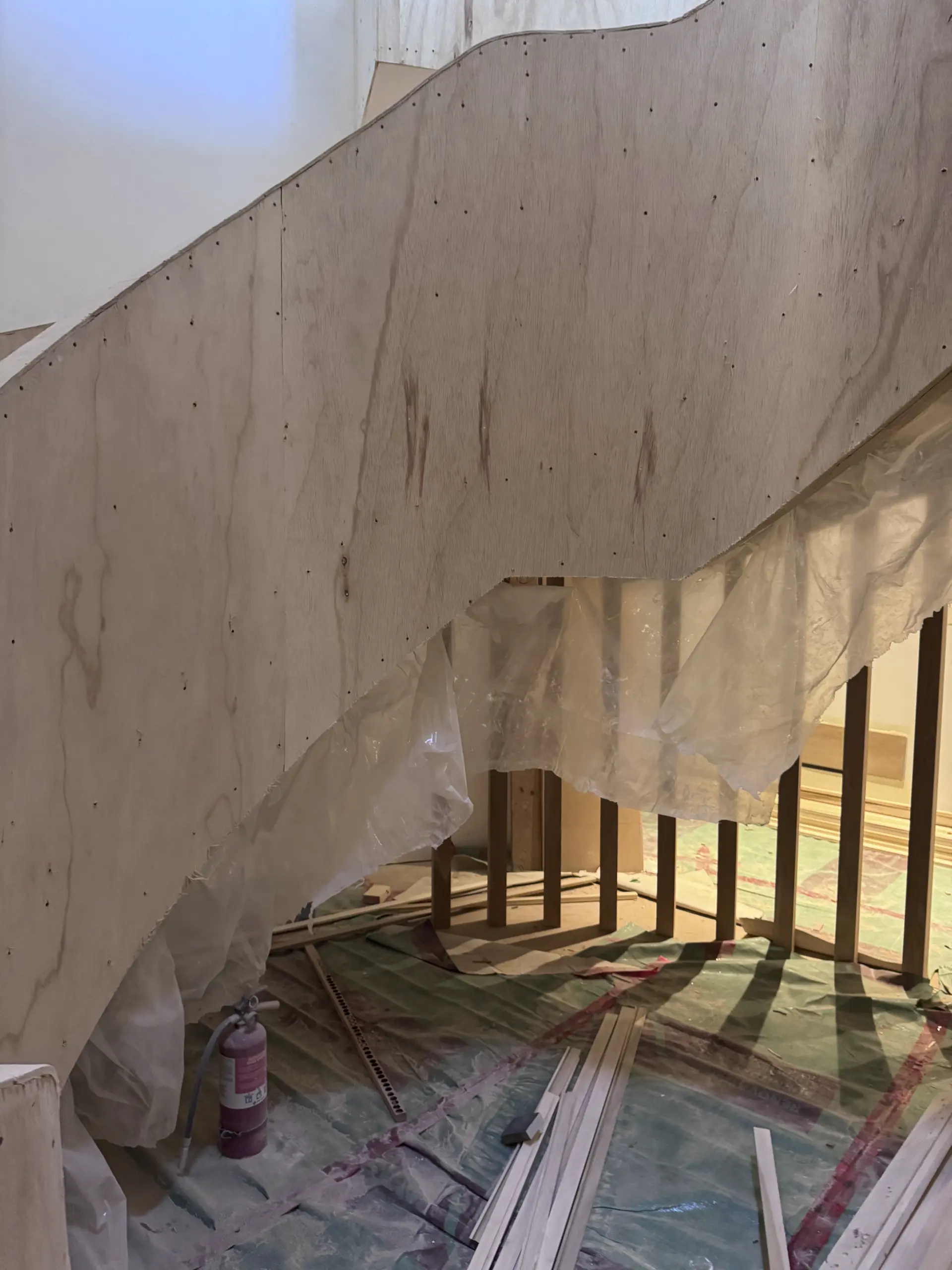
Microcement surfacing in progress on the curved staircase skirt.
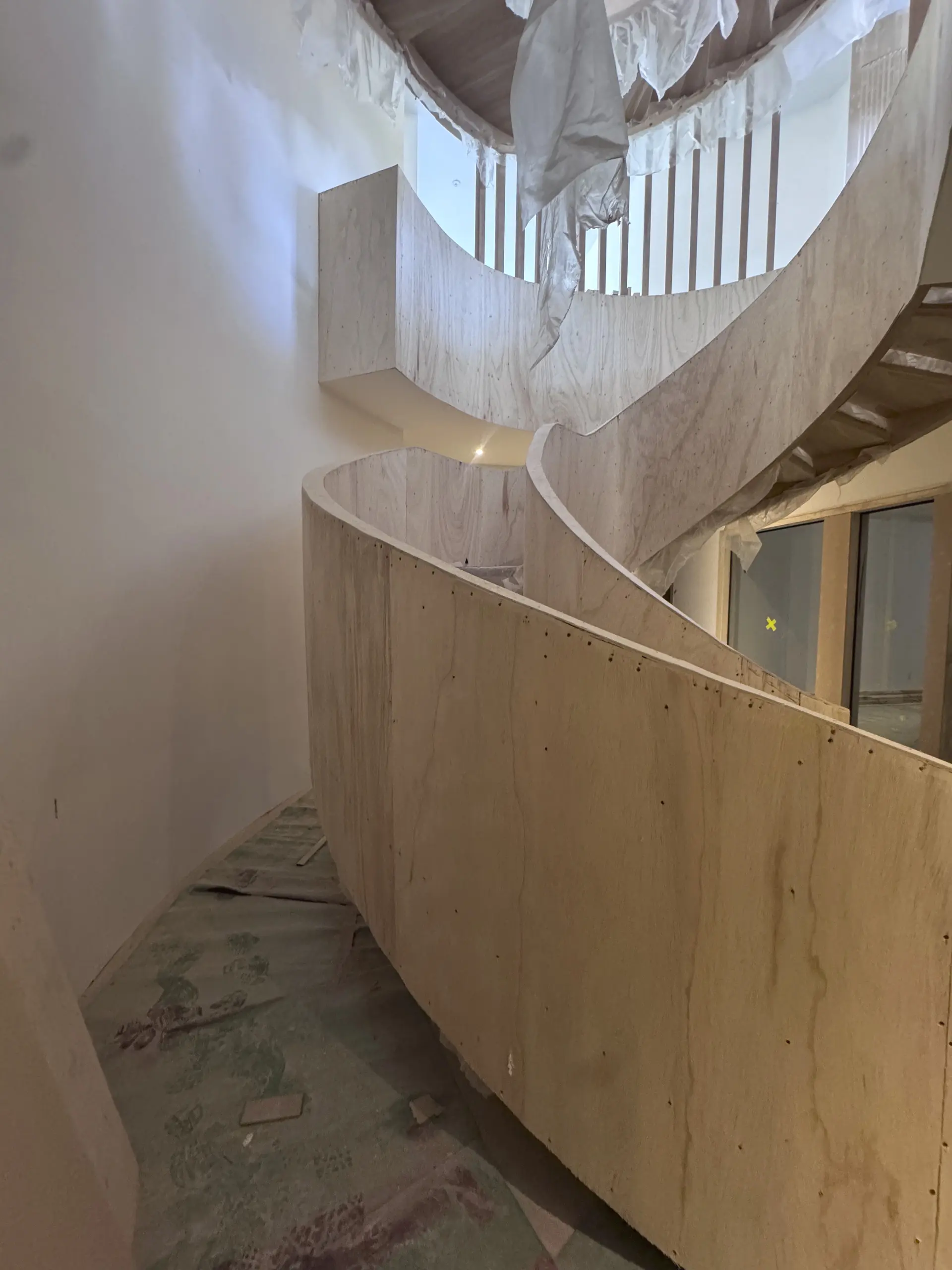
Raw MDF spiral staircase before surface preparation.
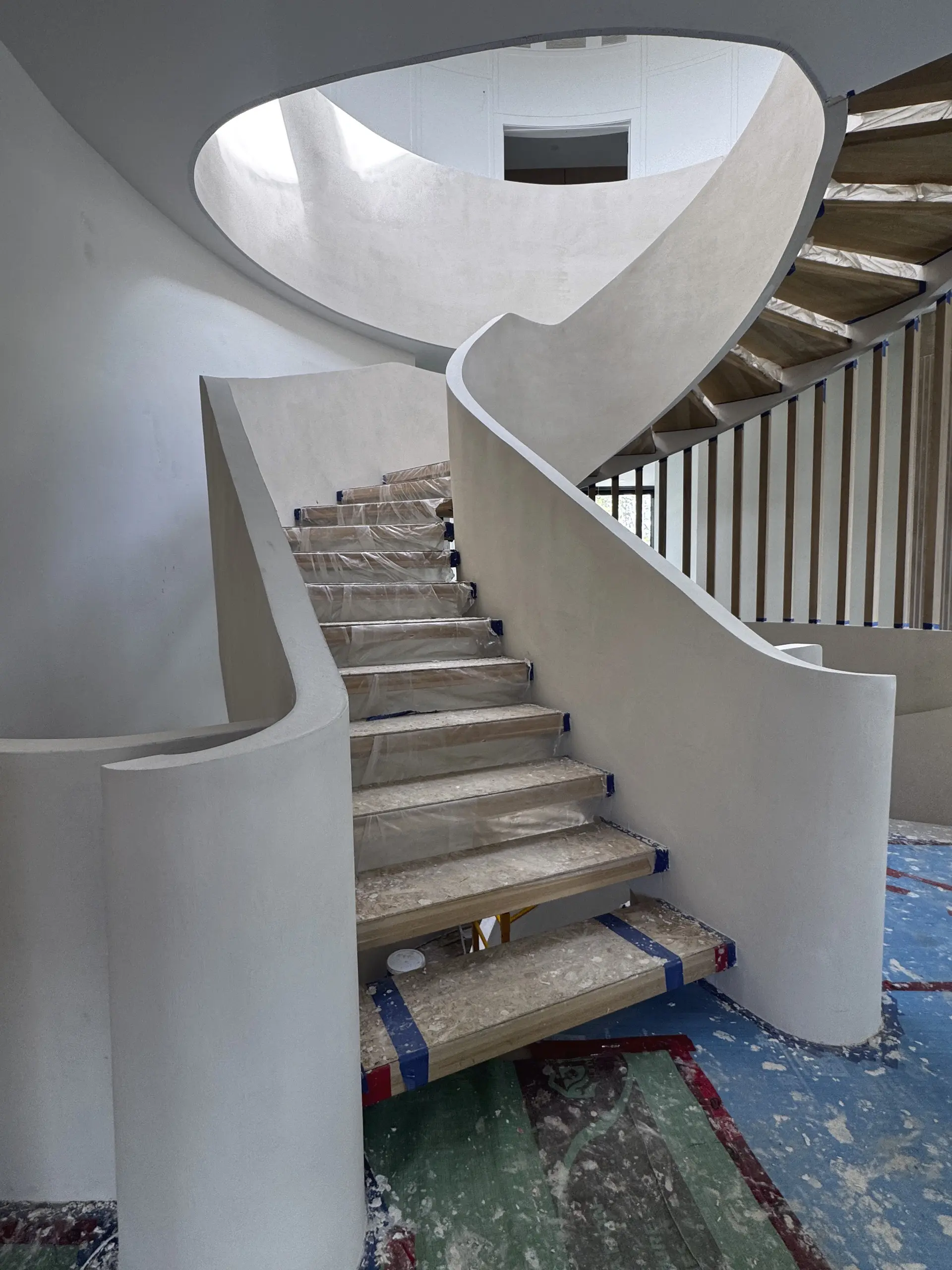
A continuous microcement surface follows the staircase’s spiral curve.
Speak to Shayan: 416 606 8060 or Request a Quote.
Why Microcement Was the Right Finish
Microcement was the appropriate solution for this staircase, but only once the structure was prepared specifically for it. The aim was a durable, continuous finish that could follow the sculptural geometry without turning the staircase into an unrelated feature.
Venetian plaster was not the right finish for the raw MDF skirt. The changing curves, detailed edges and scale of the spiral staircase called for a stronger, more robust surfacing system built around a properly prepared substrate.
On a staircase, the finish is only as reliable as the structure beneath it. Flexible corner beads were used to define and protect the spiral edges, followed by a smooth non-cementitious base layer with mesh incorporated where required. That work created the steady, continuous foundation needed for the microcement system across three levels.
The Finished Surface
Two base coats of microcement established the surface. Two medium-grain finish coats followed, developing a refined texture with controlled tonal movement. Once cured, the completed staircase was protected with a compatible microcement polyurethane sealer selected for regular use and long-term protection.
The retained wood treads bring warmth underfoot. The newly surfaced sides give the three-level spiral staircase a calm mineral presence. Rather than compete, the materials give each other a clearer role.
A spiral staircase makes every transition visible: the inside curve, the outside edge, the return to the next floor. The value of a continuous hand-applied finish is not just that it looks seamless. It allows the form to read as one architectural gesture from level to level.
Microcement has a quiet, tactile character that suits this scale of feature. Its movement is hand-trowelled rather than printed on, so the light changes softly across the curve instead of catching on a hard seam or an abrupt change in material.
Samples help establish direction, but the finish becomes fully legible only when it travels across a large, curved surface. Colour, daylight, the grain of the wood treads and the home’s existing material palette all shape the final reading.
FAQ: Microcement Stairs in Toronto
Our Reviews
Professional Preparation for a Complex Staircase
For homeowners, architects and designers considering a microcement finish in Toronto, the first question is not only colour or texture. It is whether the structure can be properly prepared for the finish.
The scope of a staircase project is shaped by its geometry, the condition and movement of the existing substrate, edge details, landings, transitions to adjoining materials, access, and the desired surface character. A site review lets us match the preparation and finish system to the architecture that is actually there.
Finished-detail image placeholder — upload the microcement texture, wood-tread transition and full-height staircase photography here.
The same professional approach applies when microcement moves across any unusual form, not only a staircase. In our Liliput custom counter and bench project, the finish was carried across commercial furniture; here, it follows a three-level spiral. The forms are different, but the principle is the same: a continuous surface succeeds because the structure beneath it has been properly prepared.
Before installation, we look at the structure’s stability, the substrate material, movement at joints and transitions, existing edge conditions, and how the staircase will be used. Microcement is a remarkable solution when the base is made ready for it; preparation is what allows the finish to remain calm and continuous afterward.
| Toronto & GTA | Projects Outside Ontario |
|---|---|
| Chromatist works on residential and commercial decorative-finish projects across Toronto and the GTA, including Vaughan. | Travel outside Ontario is considered based on the project. |