
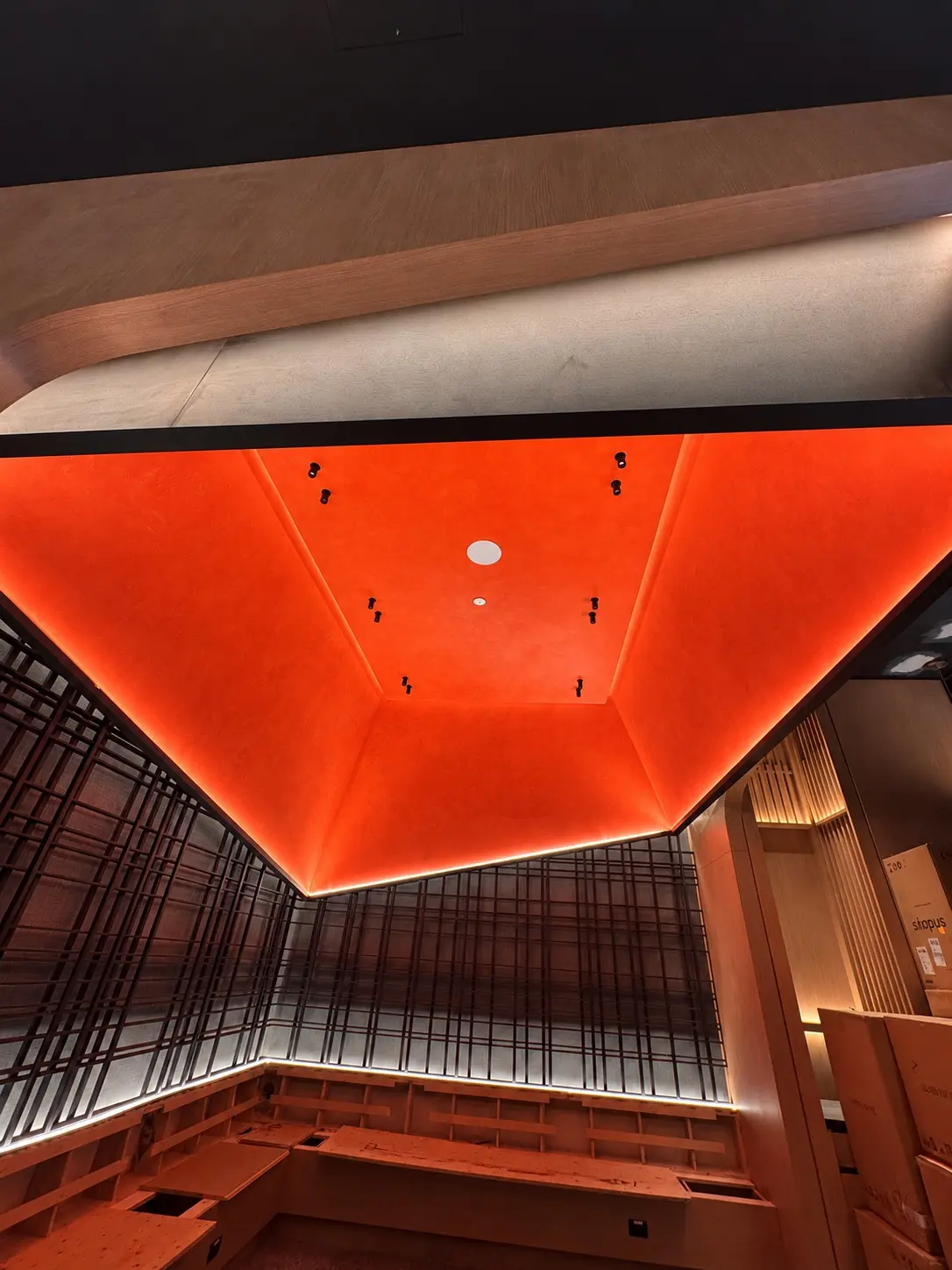
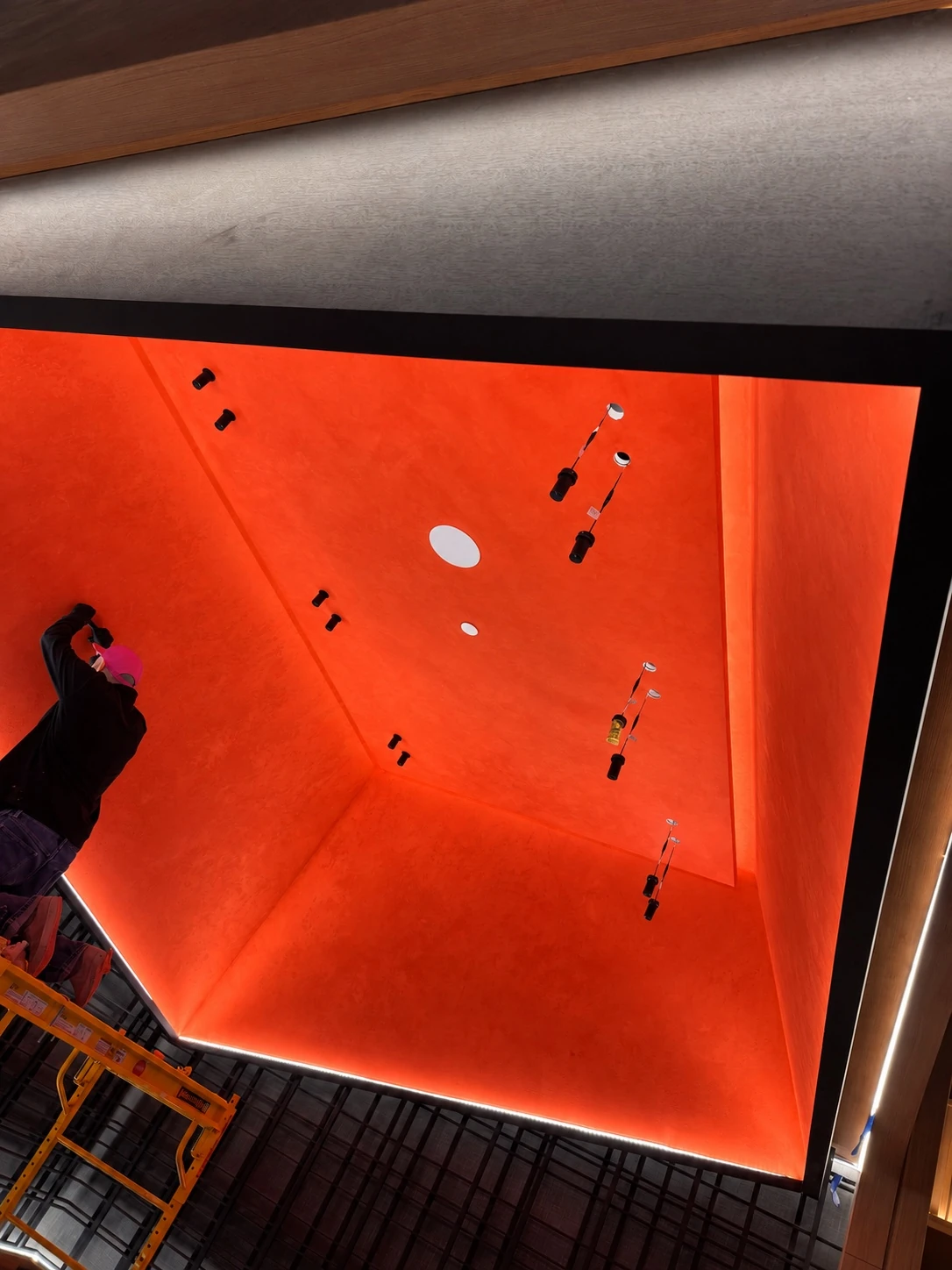
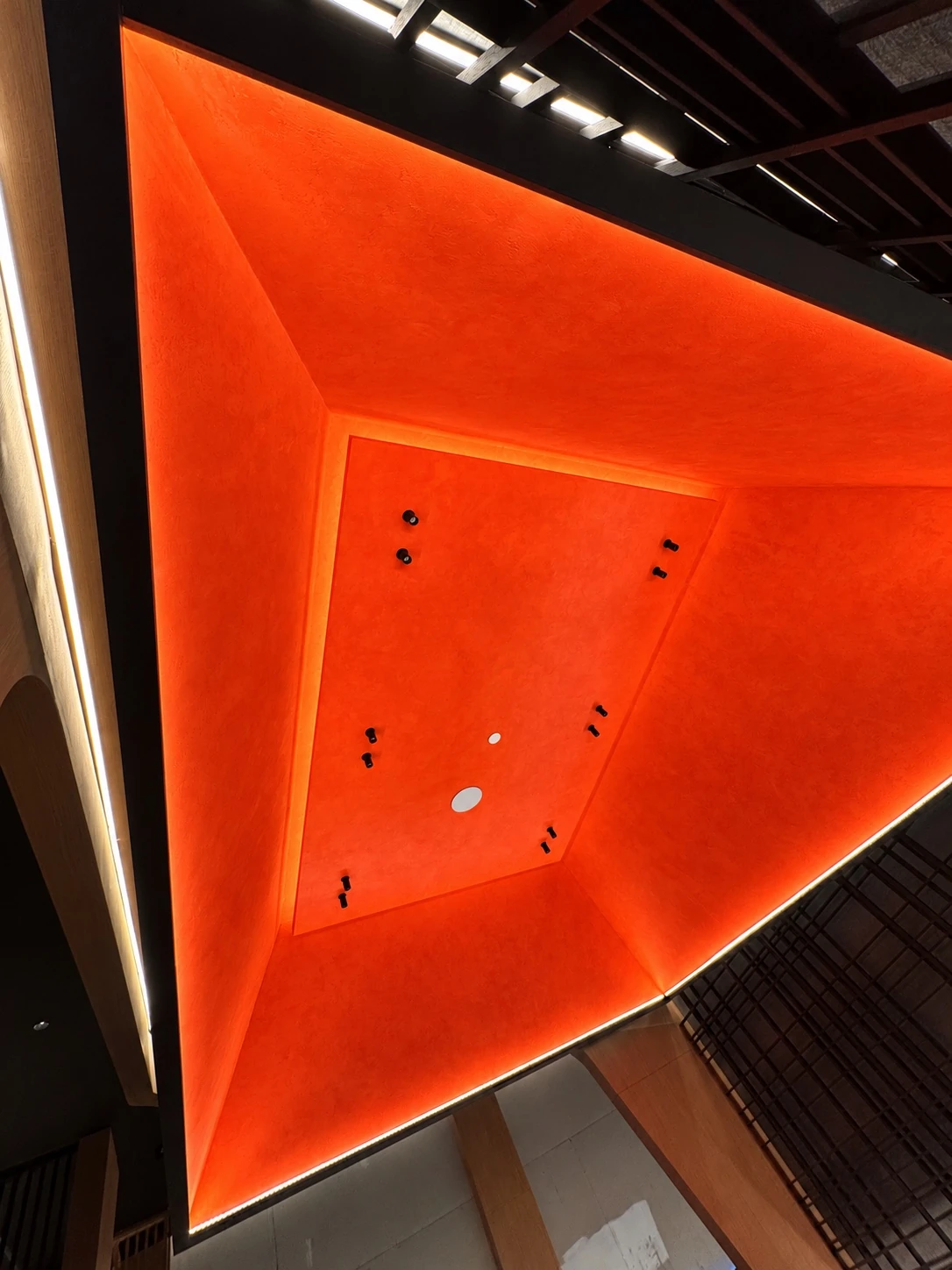
In a restaurant, the ceiling shapes the room even when no one looks straight up. It affects how light settles over the space and how the interior feels from the entrance. Limewash gives that broad plane a matte surface with shifts in colour instead of a uniform painted finish. At Toro Toro Sushi in downtown Toronto, we applied red limewash to a dropped ceiling framed by dark detailing and warm wood.
Commercial ceiling finishes are chosen in relation to the room, its lighting, and the surface overhead. During the design consultation, we compared faux finishes, lime plaster, Venetian plaster in matte and half-burnished treatments, velvet plaster, and Roman Clay. The comparison below shows the different ways those finishes can read; the completed restaurant ceiling is one example of limewash overhead.
A palette of finishes: comparing visual character
| Finish | Aesthetic character | How it reads in light |
|---|---|---|
| Faux finishes | Technique-led family that can suggest another material, from restrained to expressive. | Pattern, contrast and movement depend on the chosen reference and application. |
| Lime plaster | Mineral, hand-worked surface with irregular nuance and a soft, generally low-sheen appearance. | Texture and tonal variation feel organic rather than mechanically uniform. |
| Venetian plaster — matte | Smooth, refined surface with depth of colour and a quieter, subdued finish. | Low reflection keeps the impression calm and composed. |
| Venetian plaster — half-burnished | Selectively polished finish with more sheen and definition in the trowel movement. | Light catches burnished areas, making movement and contrast more noticeable. |
| Velvet plaster | Soft, suede-like visual impression with diffused tonal depth. | Low sheen and gentle variation create a velvety, less reflective look. |
| Roman Clay | Earthy, matte character with subtle hand-trowelled movement. | Quiet tonal shifts and minimal shine give a grounded, tactile impression. |
| Limewash | Powdery matte appearance with softly clouded colour variation. | Mottled movement shifts gently as daylight changes across the surface. |
This comparison is a visual starting point, not a fixed promise. The chosen finish system, colour, substrate, application, and the room’s natural and artificial light all shape the final appearance. Reviewing samples in the actual space helps make the differences easier to judge.
The room’s interior design was by Fourfold Studio.
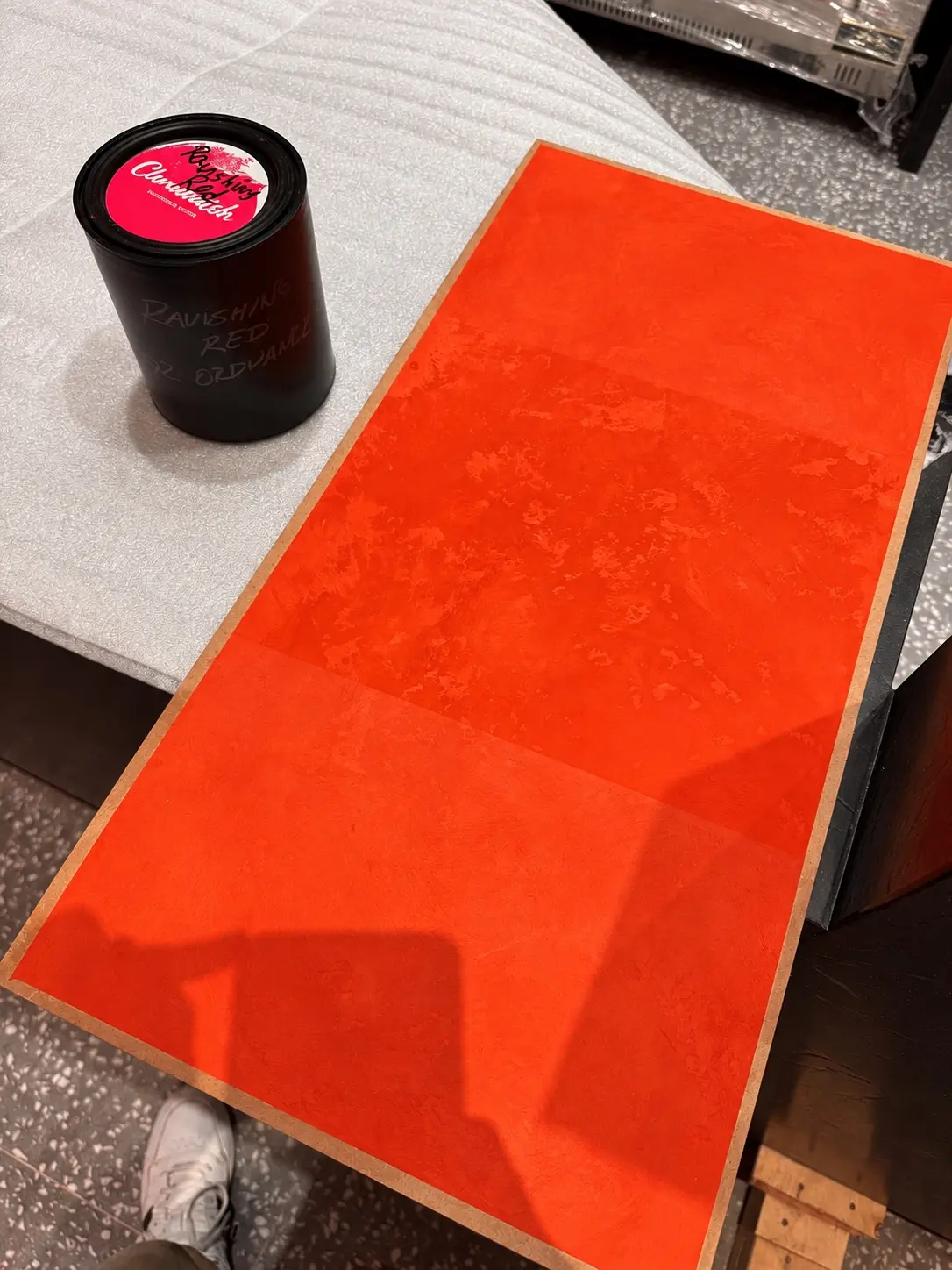
From Sample Board to Finished Limewash Ceiling
A Dropped Ceiling in the Restaurant Interior
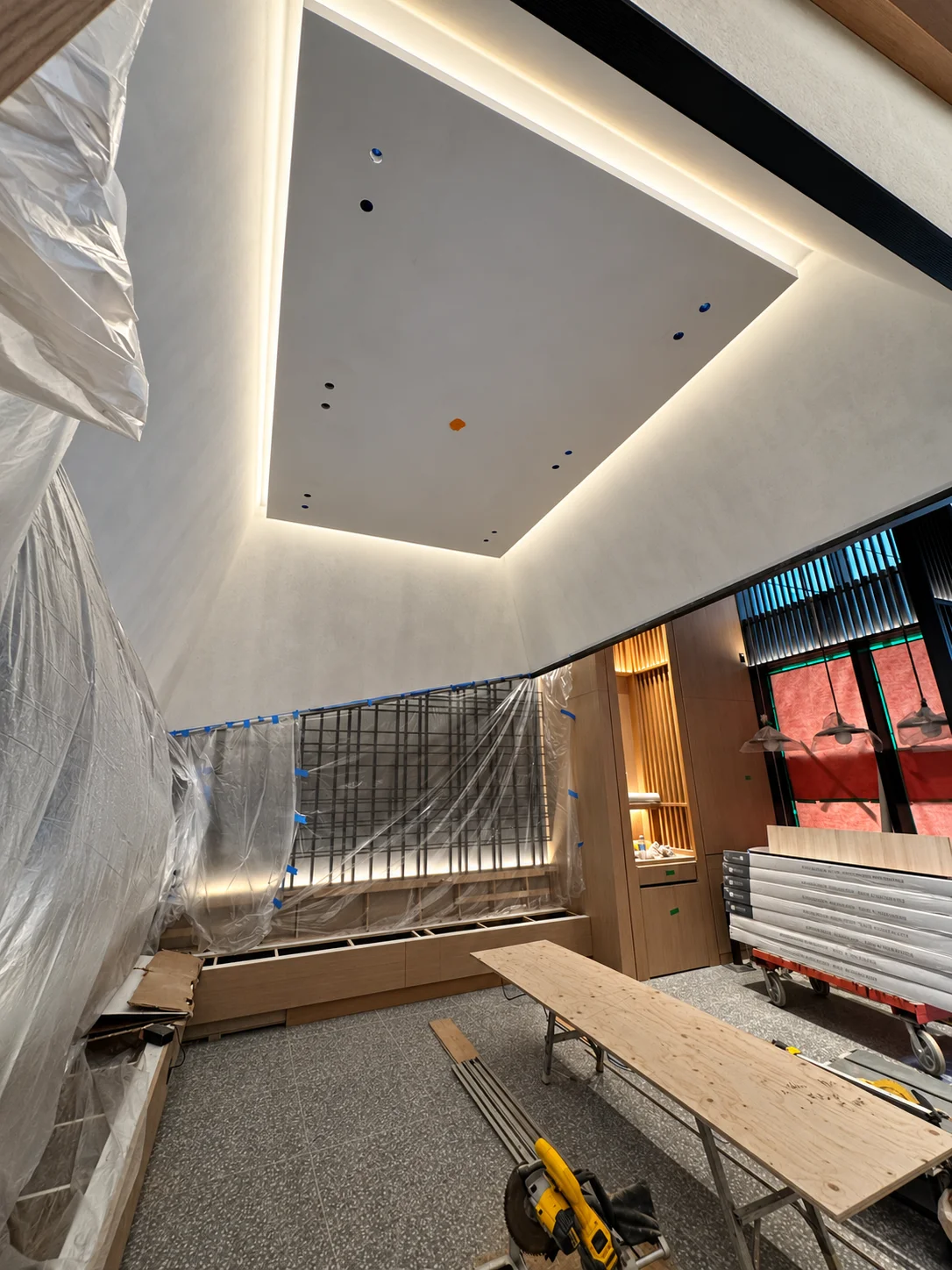
A dropped ceiling can help organise a restaurant interior. In this dining room, red limewash turns the lowered plane into a deliberate field of colour. Dark trim gives the ceiling a clear edge, while the hand-applied variation softens the broad surface.
For restaurants and other commercial spaces, this approach can bring colour overhead without a flat painted effect. The strength of the colour and amount of movement are choices to test in the actual room, under its lighting and alongside the wood, walls, and furnishings.
Colour and Light on a Restaurant Ceiling
On a restaurant ceiling, red does not hold one fixed appearance. It can look deeper beside dark trim and warmer under the room’s lighting. Limewash adds softly irregular tone to the large plane, so the colour feels layered rather than mechanically even.
That is why we review samples in the space. Ceiling height, light sources, wall colour, woodwork, and furnishings all change how a shade reads from a small board to the completed room. Those observations help settle the colour and amount of movement before application.
The finish starts with the surface
Before specifying a finish, we look at what is actually overhead: the ceiling material, existing coating, repairs, texture, and condition. Those details affect preparation and whether the proposed finish is suitable. A sound, compatible surface is the starting point; loose, glossy, patched, or inconsistent areas may need attention first. The right preparation depends on what the assessment reveals, not on a one-size-fits-all recipe.
Transitions deserve the same attention as the field of the ceiling. Perimeters, corners, lighting openings, and the point where a dropped plane meets the main ceiling all shape the finished impression. When those edges are considered from the beginning, the ceiling reads as intentional—not like a finish that stopped at the tricky parts.
Planning Limewash for a Commercial Ceiling
Commercial ceilings are seen from entrances, tables, and different corners of the room. Applying a finish overhead calls for protection of nearby surfaces, reliable access, and a sequence that keeps the finish coherent from edge to edge. Those conditions are part of the application plan, along with the substrate review described above.
Maintenance expectations matter too. We review the proposed finish with the project team and discuss how the selected system should be cared for. The right preparation and finish depend on the ceiling material, existing coating, and use of the space.
Planning a commercial limewash ceiling in Toronto? Tell us about your project below.
A ceiling that belongs to the whole room
The best ceiling choice makes sense with the interior around it. If you’re weighing finishes, our decorative ceiling guide looks at other ways to treat the fifth wall. You can also explore our limewash services and the finish options discussed above: lime plaster, Venetian plaster, velvet plaster, and Roman Clay.
For another way to shape a room overhead, see the purple-grey suede ceiling in a Toronto ensuite and the curved Venetian plaster foyer in Kleinburg. Where wood grain is meant to remain visible, our wood ceiling finish guide looks at painted and stained panels.
FAQ: Limewash Ceilings in Toronto
Plan a Commercial Limewash Ceiling in Toronto
Planning a restaurant, café, or another commercial interior in Toronto? Chromatist’s Toronto limewash contractors work with designers and project teams to review ceiling conditions, refine colour samples, and plan the finish around the room’s light and use. Share photographs, dimensions, or plans below so we can discuss whether limewash is a suitable direction.