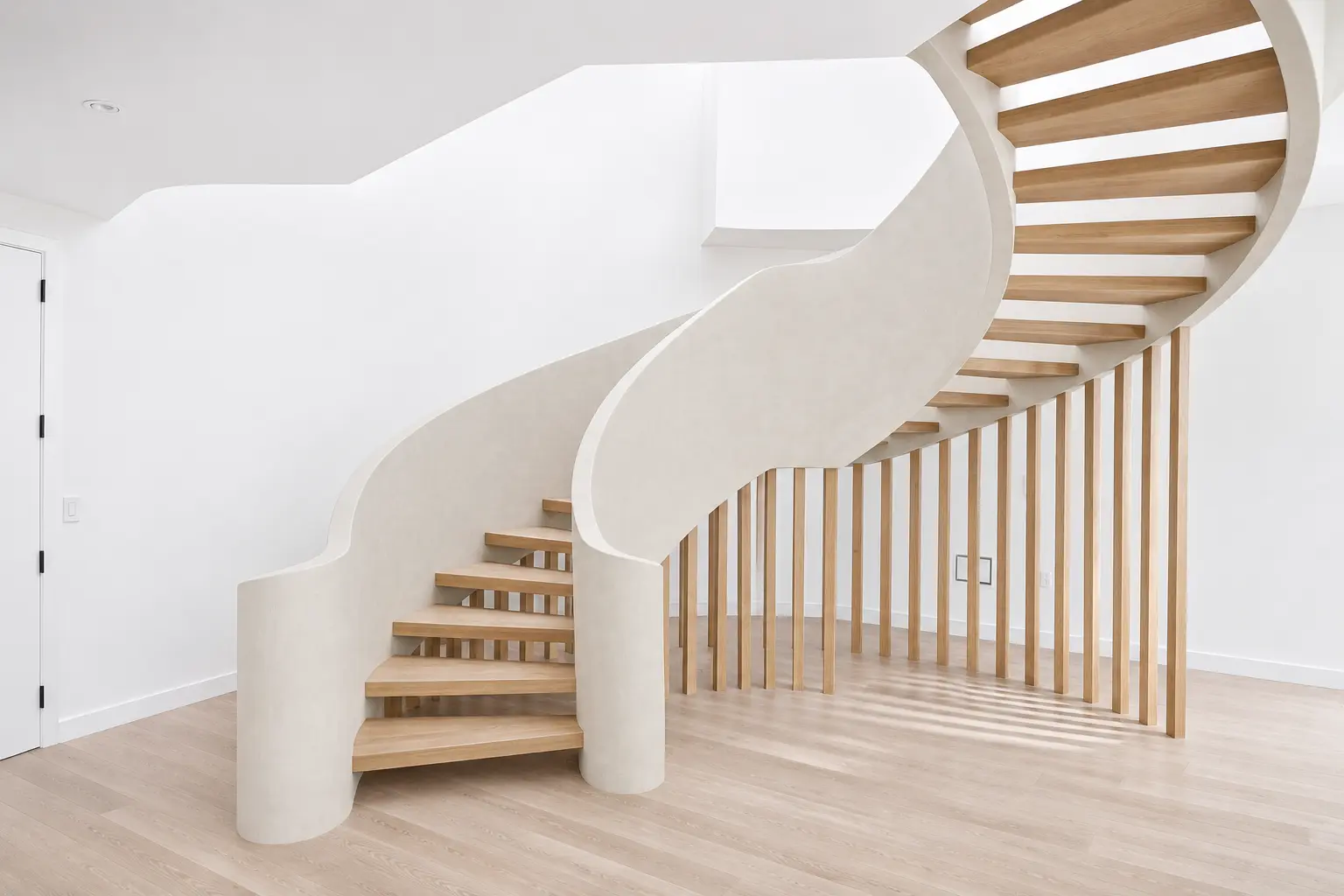

Microcement Spiral Staircase in Richmond Hill

In a Richmond Hill home, a three-level spiral staircase curves through the interior beside warm wood treads. Its unfinished MDF skirts needed a finish that could follow both sides of the stair. We coated those curved surfaces in hand-trowelled microcement, leaving the wood underfoot.

Microcement on the Curved Staircase Sides

The microcement covers the staircase skirts, not the treads. Its continuous surface follows the inner and outer curves across three levels, while the retained wood brings warmth and contrast to the finished stair.

Finished spiral staircase with pale microcement curved sides and exposed wood treads in Richmond Hill.
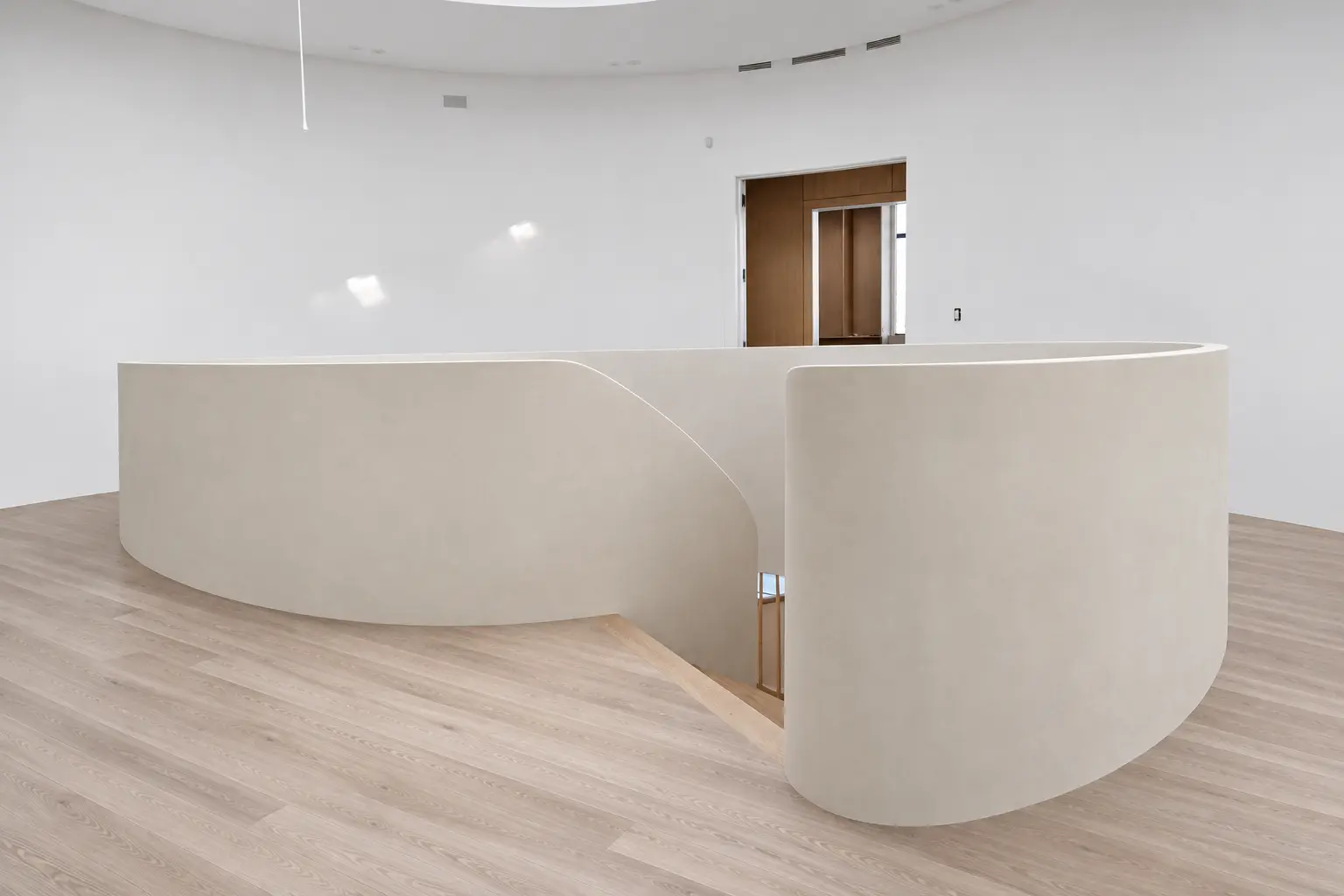
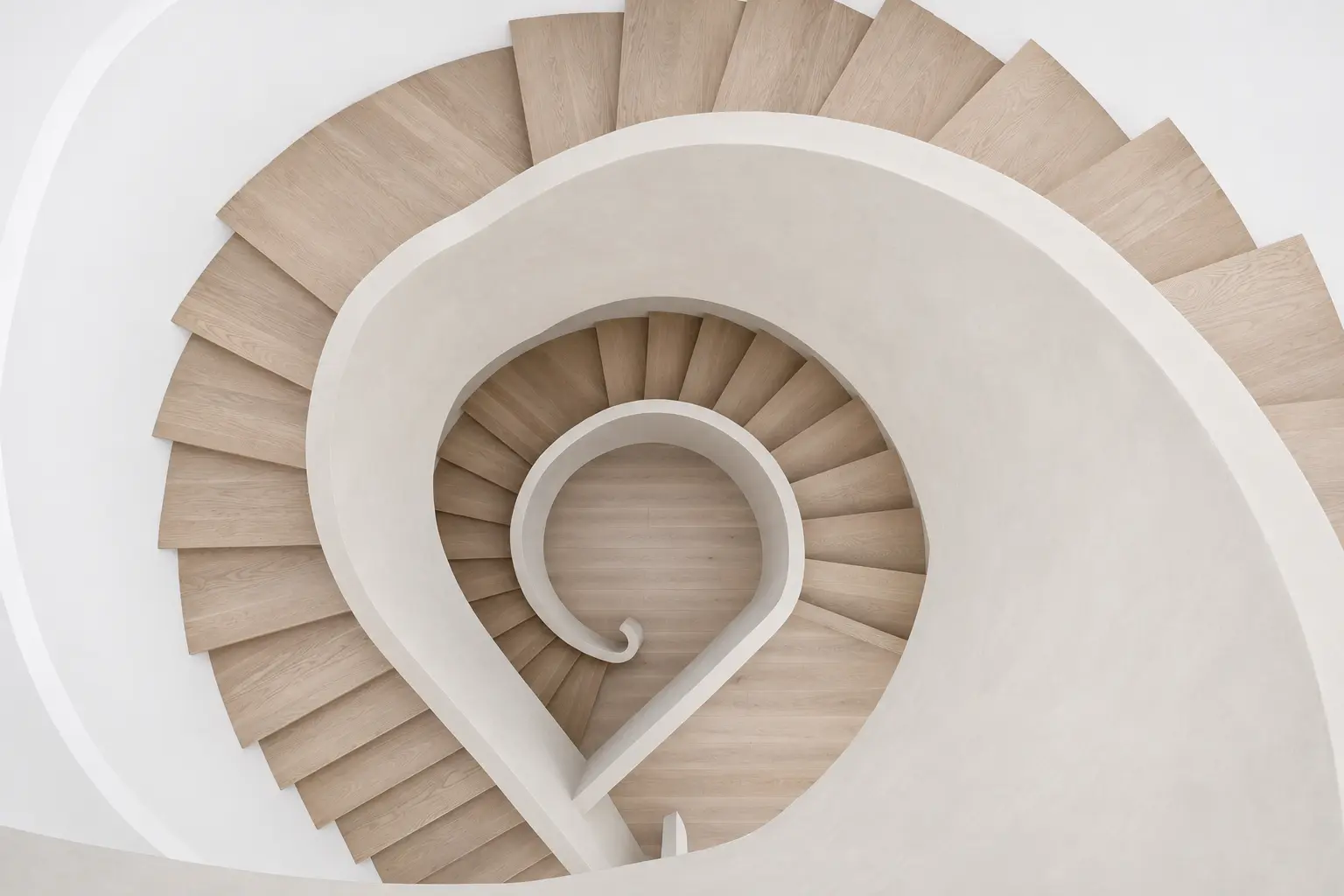
From the upper landing to the lower level, pale microcement follows the spiral while warm wood treads define each step.

Speak to Shayan: 416 606 8060 or Request a Quote.

Preparing the MDF for Microcement

We reviewed the substrate, joints, edges and transitions before application.

Flexible corner beads defined and protected the curved edges. A smooth non-cementitious base layer, with reinforcing mesh where required, created a consistent foundation for the finish.

We then applied two microcement base coats and two medium-grain finish coats. A compatible polyurethane sealer completed the system.

The Look of a Microcement Staircase

The pale microcement follows the staircase’s inner and outer curves without interrupting their shape. Its hand-trowelled finish has subtle shifts in tone; as light moves across the stairwell, the curves look soft rather than flat or painted.

We kept the wood treads visible. Their grain brings warmth to the light mineral finish and makes each step distinct, while the finished sides carry the spiral through all three levels. Seen from above or from the room below, the staircase reads as one considered architectural form.

Microcement finish in progress on the curved staircase, with the wood treads protected.

Planning Microcement for Other Stairs

Each staircase needs its own assessment of substrate stability, movement, edges, landings, access and intended use. Side walls, risers and treads have different wear requirements. A microcement tread also needs a separate review of nosings, grip, protection and maintenance; the treads in this project remained wood.

Project scope depends on the number of levels, curvature, substrate preparation, edge details and access. Photographs and drawings help us assess which surfaces can be finished and how to prepare them. Learn more about our microcement installation services in Toronto and the GTA.

FAQ: Microcement Stairs in Toronto

What affects the cost of a microcement staircase?2026-11-20T11:55:34-05:00

The scope depends on which surfaces are being finished, the number of levels, curvature, substrate condition, edge details and access. Curved sides such as these require a different preparation plan from coated risers or treads. Photos and drawings help us define that scope before quoting.

What colours and textures can a microcement staircase have?2026-11-20T11:55:17-05:00

Colour and the degree of visible trowel movement can be chosen to suit the surrounding materials. Samples should be viewed in the stairwell’s own light, especially on a large curved surface where subtle variation becomes more visible. Here, a pale neutral finish sits alongside the wood treads.

Is microcement slippery on stairs?2026-11-20T11:54:29-05:00

Grip matters when microcement is used on treads. The texture, sealer, nosing and intended use need to be assessed together. On this Richmond Hill staircase, the treads remained wood; we applied microcement to the curved sides.

Can microcement be used on stairs?2026-09-29T15:25:11-04:00

Microcement can be considered for stair risers, side walls or stringers, and selected tread surfaces when the base, edge details, intended use and chosen system have been assessed. The right preparation lets the finish move continuously across the staircase rather than treating each element as a separate material.

Can microcement be used on stair treads?2026-09-29T15:25:11-04:00

Microcement can be specified for stair treads in the right project, but tread surfaces need a case-by-case review for foot traffic, nosing details, wear and the appropriate grip and protection system. Retaining wood treads, as in this project, is one option; a microcement tread requires its own technical assessment.

Can microcement be applied to different staircase styles?2026-09-29T15:25:11-04:00

Yes. Straight, L-shaped, U-shaped, floating, curved and spiral stairs can all be assessed for microcement surfacing. The important factor is not the style alone; it is whether the substrate, joints, edges and transitions can be prepared into a stable base for the selected system.

Can microcement be applied over existing stairs?2026-09-29T15:25:11-04:00

Existing stairs may be candidates for microcement when their structure is sound and the surface can be properly prepared. The existing material, movement, previous coatings, edge conditions and transitions all determine the preparation strategy.

Why do microcement stairs need professional installation?2026-09-29T15:25:11-04:00

Stairs bring together changing planes, edges, joints and daily use. Professional installation coordinates the substrate assessment, reinforcement, edge preparation, finish application and system-compatible protection so the finished surface is appropriate for the architecture and use.

How are microcement stairs protected for everyday use?2026-09-29T15:25:11-04:00

After the selected microcement finish has cured, it is protected with a compatible sealer. The appropriate system and maintenance guidance depend on whether the finish is on risers, side walls, treads or another stair element, as well as the level of daily use.

Our Reviews

For another use of microcement on curved forms, see our curved fireplace and range hood project in Kleinburg. Explore more microcement projects to see where the finish has been applied.

Discuss a Microcement Staircase

Share photographs or drawings and tell us which parts of the staircase you would like finished. We can review the existing structure and discuss a suitable finish direction.

Project type:
Toronto & GTA Projects Outside Ontario
Chromatist works on residential and commercial decorative-finish projects across Toronto and the GTA, including Vaughan. Travel outside Ontario is considered based on the project.

Go to Top